

About
The University of North Carolina, Copperbelt University and the Center for Energy, Environment and Engineering (CEEEZ) are undertaking an impact evaluation of two, private sector-led, clean cooking interventions on adoption and sustained use of clean cooking technologies, charcoal use, household expenditures on cooking energy, exposure to household air pollution, and self-reported indicators of health. Two firms are piloting clean cooking products in Lusaka with plans to scale up to tens of thousands of customers in the next 1-5 years. Baseline data were collected in July/August 2019 and two adoption and promotion assessments were collected via telephone survey in April 2020 and December 2020. A summary of findings from the first two rounds of data collection are available on the Project Outputs page.
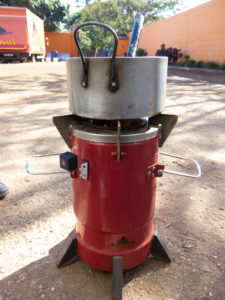
Supamoto is marketing the Mimi Moto fan microgasification cookstove (red stove pictured right) and biomass pellets to households in Lusaka, Zambia. Vitalite is marketing efficient charcoal stoves, called the EcoZoom (blue stove pictured below), to households in Lusaka.
Click here for the survey instrument used for baseline data collection.
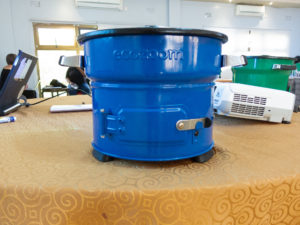
VITALITE’s EcoZoom improved charcoal stove
Projects
An application of Best Worst Scaling (BWS) to understand buyer priorities for cookstoves in Zambia
Contact: Wiza Munthali, PhD student at NC State University
The main objective of the BWS module in the ZCCS survey is to understand buyer priorities for cookstoves within the sampled study locations. To elicit the utility for different attributes, each respondent was presented with a hypothetical scenario that presented a kind of cookstove technology. These scenarios were described by a total of five attribute levels, of which were changed over the different scenarios. In each scenario, the respondent then indicated which item encouraged them the most to buy the cookstove (best) and which encouraged them the least (worst). A total of 28 attribute levels were developed for this study. The BWS was administered to both improved cookstove users and prospective users, and a total of 506 households were interviewed.
Carbon Monoxide Exposure and Cognitive Function Among Cooks in Lusaka, Zambia
Contact: Ryan McCord, Project Manager at UNC Chapel Hill
This paper uses personal exposure measurements, self-reported health symptoms, and neurocognitive test scores of primary cooks in urban Zambian households to explore the impact of CO on cognitive function. We measure 24-hour carbon monoxide exposure of 431 primary cooks in Lusaka, Zambia. We quantify the consistency between self-reported versus quantitatively estimated neurocognitive health effects determined from estimated %COHb calculated from the CO exposure, and we compare %COHb levels to neurocognitive test scores administered to cooks in their homes.
Impacts of stove type on primary cook health: Evidence from Lusaka, Zambia
Contact: Kate Brandt, PhD student at UNC Chapel Hill
The negative health impacts of fuel burning and exposure to air pollution are well documented in public health and energy poverty literatures. One aim of many improved cookstove interventions is the reduction of adverse health impacts such as cough, headaches, eye irritation, and burns for primary cooks and other members of households that rely on biomass fuel for their cooking needs. The 2019 baseline survey of the Zambia Clean Cooking Study includes data on stove use, cooking practices, and self-reported health outcomes for primary stoves in four compounds in Lusaka, Zambia. From this cross-sectional survey of 1,377 households, preliminary evidence suggests that improved cookstoves (including the EcoZoom, MimiMoto, and electric stoves) have significant advantages over traditional stoves and cooking methods to protect against adverse health impacts. These findings add to the growing evidence base in support of cookstove interventions for populations where ubiquitous electricity access has not been achieved.
Comparison of Personal Exposure Data for Urban Zambia and Malawi and Rural Malawi
Contact: Stephanie Parsons, PhD student at NC State University
During the 2019 baseline campaign of the ZCCS, 24-hour carbon monoxide (CO) and particulate matter (PM2.5) personal exposure was measured for the primary cooks in a subset of participating households. The primary cooks were asked to wear both monitors in their breathing zone for 24 hours, with the PM monitor collecting measurements ever 10 seconds and the CO monitor every minute. The 24-hour averages and hourly trends of both pollutants are compared across compounds, throughout the day, by primary stove type, by intervention status, etc. In 2013 and 2014, similar personal exposure data were collected in rural and urban Malawi under a separate project. The 24-hour CO and PM averages and hourly CO trends are compared by rural versus urban Malawi, urban Malawi versus urban Zambia, primary stove type, etc.
If you would like to get in touch with the primary contact for a paper, please email [email protected] to be connected.
Data Access
To date, we have collected baseline data for the Zambia Clean Cooking Study (ZCCS), which examines determinants of adoption and the impact of use of two different improved cookstoves in Lusaka, Zambia. The data were collected in 2019 as the first wave of a 2-wave impact evaluation. A structured household questionnaire was conducted with each survey household with the following modules: household roster; cook status, health, and time use; facilities; assets; savings and credit; cooking practices; short recall cooking; willingness to pay; best worst scaling; household energy expenditures; household other expenditures; awareness of clean cooking firms; perceptions; social capital; fuelwood weighing; and cognitive function. Baseline reports summarizing our initial findings are available under Publications & Outputs. We will return to these households when possible to collect endline data.
Only the household survey data are available by request at this time through the CPC Data Portal. If you would like to request access to the GPS locations of the survey households, further security measures will be required. To request the data, you will be required to fill out a data request form and a data use agreement. Once you have been approved, you will be able to access the data through UNC’s Dataverse.
The following files will be available:
- Raw, de-identified data
- Stata do file to show data cleaning process
- Clean, de-identified data
- Summary statistics in Excel
- Household questionnaire
Outputs
Peer-Reviewed Publications
Parsons, S., Tanner, K., Champion, W. and Grieshop, A., 2022. The effects of modified operation on emissions from a pellet-fed, forced-draft gasifier stove. Energy for Sustainable Development, 70, pp.259-271. https://doi.org/10.1016/j.esd.2022.08.004
Briefs & Reports
- Baseline report for implementing partner SupaMoto
- Suggested Citation: EPPSA and PEER Study Team. 2021. Zambia Clean Cooking Study (ZCCS): Baseline report for implementing partner SupaMoto. Carolina Population Center, University of North Carolina at Chapel Hill. https://doi.org/10.17615/hjzf-gs31
- Baseline report for implementing partner VITALITE
- Suggested Citation: EPPSA and PEER Study Team. 2021. Zambia Clean Cooking Study (ZCCS): Baseline report for implementing partner VITALITE. Carolina Population Center, University of North Carolina at Chapel Hill. https://doi.org/10.17615/jatn-8h22